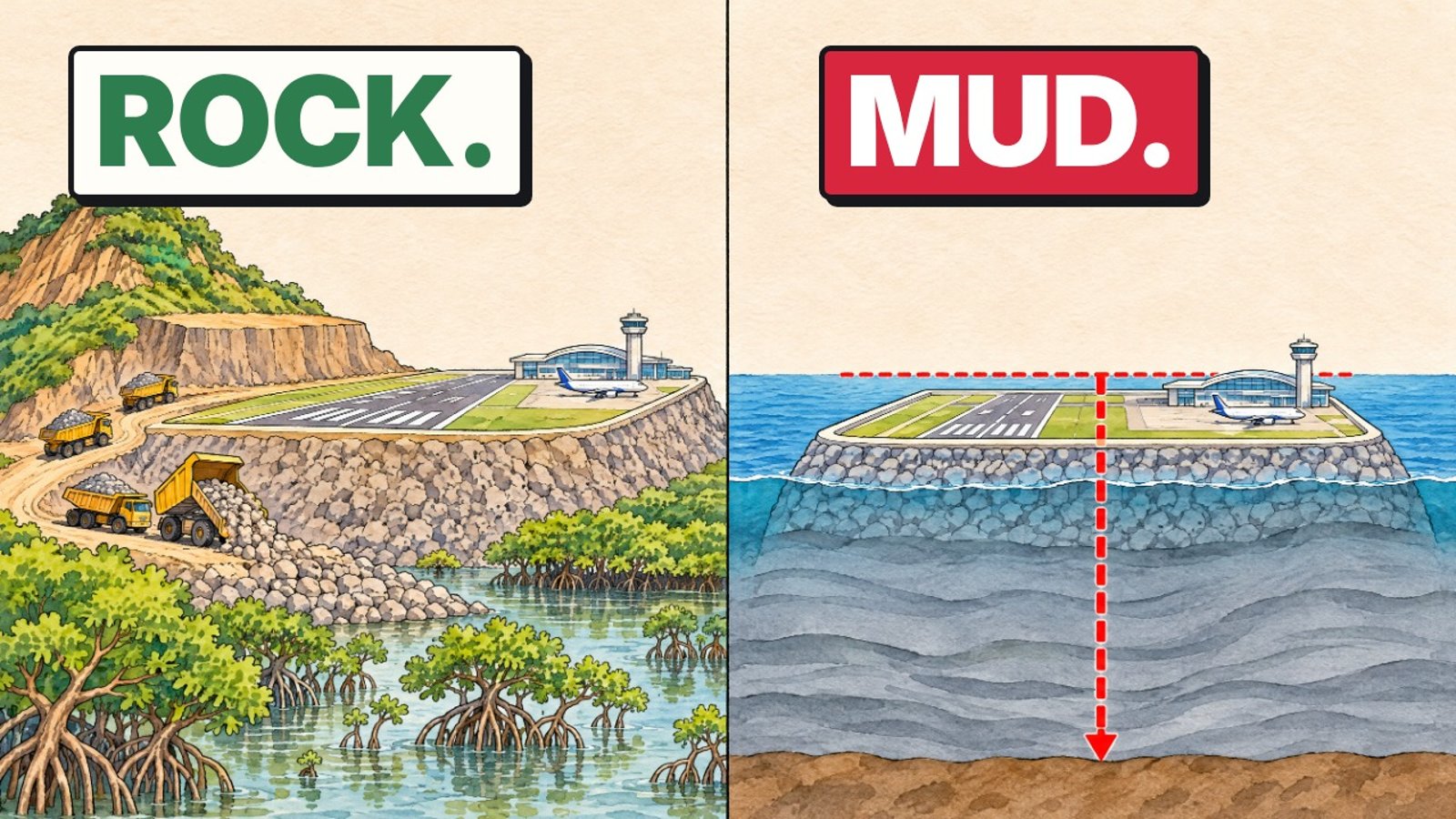
India and Japan both built a major airport on soft, wet ground, but they started from opposite places. At Navi Mumbai, builders cut a hill of about 90 metres down to about 10 metres, diverted the Ulwe River and used the rock to raise a low, waterlogged site to more than 5.5 metres above mean sea level (Airport Technology) (Engineering News-Record). At Kansai, Japan built an island about 5 kilometres out in Osaka Bay, on clay that was mostly water. Since reclamation began, the seabed under Kansai's original island has sunk 13.72 metres on average, and it is still going down (Kansai Airports).
Room to build
Both countries chose wet ground because it was the room that was left. Mumbai's existing airport is boxed in by the city; Navi Mumbai is its second airport, across the harbour on the mainland. Its site was low-lying, at about zero to two metres above mean sea level before work began (Business Standard), with mangroves, mudflats, a river and a hill. The hill was flattened, a roughly 3.2 km channel was built for the river (E3S Web of Conferences) (Engineering News-Record), and the site was filled with the cut rock (Airport Technology). Passenger flights began in December 2025.
Osaka ran out of room differently. Its older airport at Itami sits among homes, and decades of aircraft-noise disputes pushed Japan to build its new airport offshore, in water about as deep as a six-storey building is tall.
A sponge under the sea
Navi Mumbai's site does have soft marine clay, but its environmental report describes it as roughly 0.5 to 2 metres in the east and probably 6 to 8 metres in parts of the north. Under Kansai's original island the soft alluvial clay was about 20 metres thick, and about 70% of it by volume was water (Kansai Airports). Engineers drove about a million sand drains, 20 metres long, into that clay so the water could escape; the top layer finished settling within about a year (Kansai Airports). The older layers below, up to about 400 metres thick, could not be drained, and they are why the island still sinks (Kansai Airports).
The totals are large: 13.72 metres of seabed settlement under the original island (17 measuring points, December 2025) and 17.67 metres under the second island, which opened in 2007 (Kansai Airports). But the rate has slowed. The original island sank 5 cm in the latest year, and less than 10 cm a year since 2007, because clay stiffens as water leaves (Kansai Airports).
Lifting a terminal
Ground that sinks unevenly is the real problem for a building. Terminal 1 stands on about 900 columns; when settlement tilts part of the building toward its limit, crews jack up the columns that dropped and slide steel plates underneath, around a centimetre per lift (Kansai Airports) (Japan Society of Civil Engineers). Because the main building's basement made its middle lighter than the rest, iron ore was laid underneath as extra weight (Kansai Airports).
The walls
On 4 September 2018, the airport's 24th birthday, Typhoon Jebi pushed the sea 1.20 metres above the astronomical tide in Osaka Bay, and waves overtopped the seawalls (MLIT Kinki Regional Development Bureau). Most of the original island flooded; a study by airport engineers put the overtopping at about 2.25 million cubic metres (CiNii / JSCE). A tanker that had dragged its anchor struck the only bridge to the mainland, and thousands of people were stranded overnight (World Economic Forum).
Japan then raised the seawalls on the original island by 1.5 to 2.7 metres, finishing in October 2021, earlier than the 2023 target (Kansai Airports) (Kansai Airports via ACI Asia-Pacific). The new design allows for rougher seas and for ground that keeps settling. Engineers estimate the same storm today would bring in about 10,000 cubic metres of water, roughly four Olympic pools, against roughly a thousand in 2018 (MLIT Kinki Regional Development Bureau).
After opening day
Navi Mumbai started from a different place: mostly rock fill, with thinner clay in places, not an island on deep sea clay. We could not find a published long-term settlement forecast for it, so we have not made one. What Kansai shows is the work that comes after opening day: measuring the ground every year, lifting the building where it tilts, and raising the walls. Japan never stopped its airport sinking. It just never stopped measuring it.